The Fabric Rule Morocco Teaches You Fast
Javier's Take
Choose linen or natural technical fabrics for Morocco. Both breathe in souk heat, cover modestly by default in loose cuts, and pack to almost nothing. Synthetic performance fabrics feel wrong against Moroccan warmth and read wrong in traditional spaces. Natural is both practical and culturally appropriate.
Morocco's temperature swings are extreme in a way that surprises most visitors. Marrakech midday in summer can touch 40 degrees. The same evening, a riad courtyard drops to something close to cool. The Atlas in any season asks for a real layer. Chefchaouen in March is jacket weather. What works across all of it is not volume — it is the right fabric logic. Layers beat single heavy items every time.
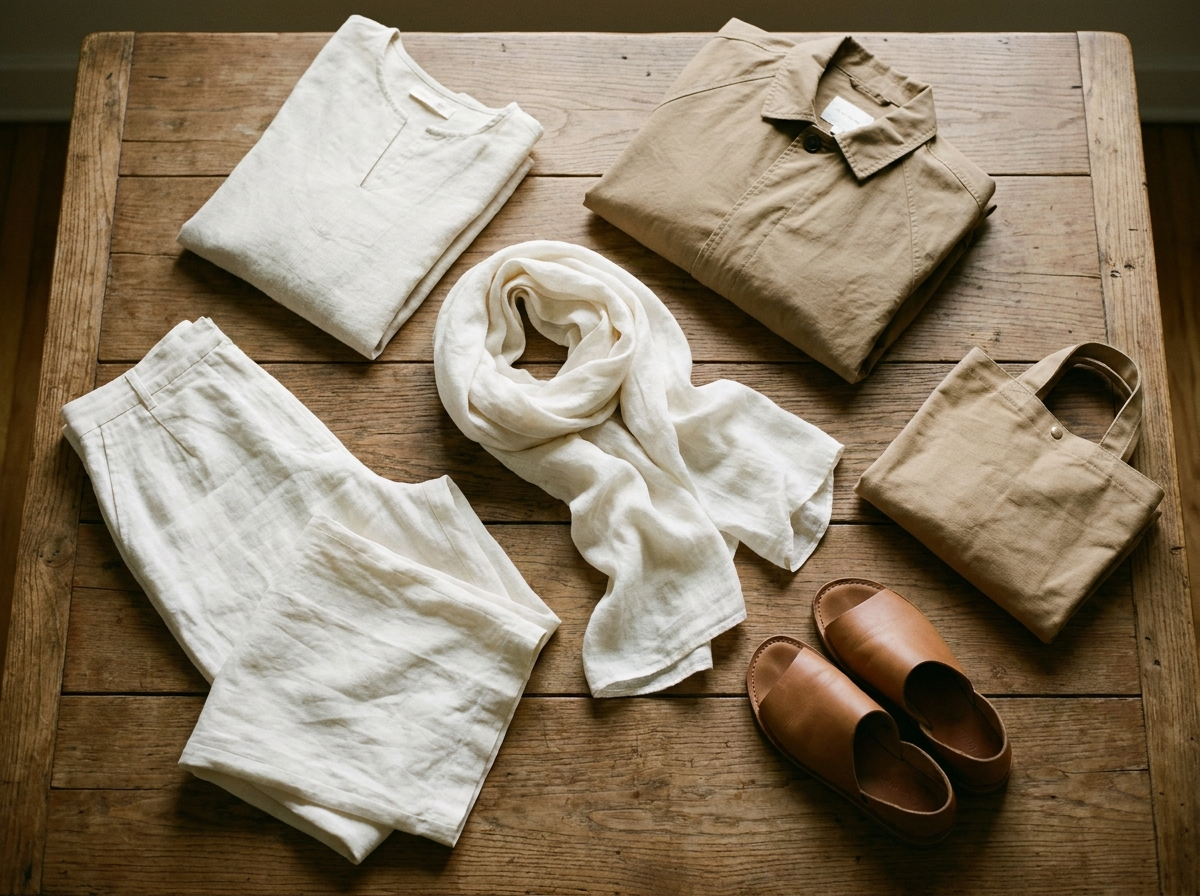
Linen earns its place because it is the material Morocco itself wears. Loose, breathable, naturally modest in a wide-cut. When Javier carries wide-leg linen trousers and a loose linen long-sleeve tunic, the choice is not about looking local — it is about moving the way Morocco requires you to move.
Natural fabrics fill the gap when linen feels too relaxed — the kind that holds its shape after a hand wash in a riad sink and dries overnight. For a three-month stay without predictable laundry access, that matters more than any other spec on a clothing label.
The Hammam Consideration — What Nobody Tells You
Javier's Take
What you wear into a hammam matters less than what you wear out. After the heat and the scrub, your body is tired and wants something effortless. Loose linen trousers and a soft tunic — your default Morocco walking outfit — double as perfect hammam exit wear. Pack deliberately for this transition.
The hammam is not a spa visit. It is a ritual that has been happening in Moroccan neighborhoods every morning for centuries. The ghassoul clay, the black soap, the kessa mitt scrub — Javier has written about all of these from inside the hammam itself. What the ritual writing never covers is the afterward.
You emerge from a hammam feeling lighter than your own skin. The heat and the scrub leave the body in a particular state: warm, open, slightly stunned. What Javier reaches for every time is the same outfit he wore in: loose linen trousers and a soft tunic. Easy to put back on. Not fighting the body's new state.
For Atlas excursions or cooler coastal days, one addition: a packable Patagonia layer that compresses to nothing in a day bag. The medina does not need it. The mountains always do.
The Cultural Layer — Dressing With Intention in Morocco
Javier's Take
Morocco's dress culture operates on a spectrum — cosmopolitan Casablanca reads differently than the ancient medinas of Fes or Atlas Amazigh villages. The single most versatile object a slow traveler carries is a large natural scarf: headscarf, shoulder cover, sun protection, and warm evening layer in one piece.
Generic Morocco packing lists collapse the country into a single modesty rule and move on. Three months reveals the gradient. In Agadir and Essaouira, the Atlantic coast towns, the register is relaxed. In the ancient medinas of Fes and Marrakech, the same outfit is appropriate for a different reason. In Atlas Amazigh villages, the dress code reflects a cultural identity centuries older than either city.
The travel scarf solves more problems in Morocco than any other single object. Javier carries the Dreamsoft organic cotton travel wrap — headcover for mosque entrances, shoulder cover in conservative medina sections, sun protection crossing open desert spaces, and a warm layer on cool riad evenings. One object. Infinite configurations.
One category worth noting: the medina souks are one of the best sources of travel clothing in the world. Djellabas, embroidered tunics, handwoven cotton wraps — buying locally is part of the slow-travel practice. Javier arrives with the core pieces and lets Morocco fill in the rest. A packable Baggu tote in the day bag makes this possible without checking a bag on the way home.