A two-ingredient powder made from dried poppy petals and pomegranate rind. Used in Moroccan hammams for over a thousand years as a lip stain, cheek tint, skin treatment, and anti-aging mask. The women of Fez have never stopped using it. There is a reason for that.
What is Aker Fassi? It found me before I knew what to call it — a small clay pot on a souq stall in Fez, a vendor's grandmother pressing deep red powder to her lips like a morning ritual. I had no idea I was looking at a thousand years of Moroccan beauty science.
It was my third morning in Fez. The medina was already alive — bread vendors, leather tanners, the distant call to prayer still echoing off the riad walls. I had come for the architecture. I stayed for what I found in that stall.
What is Aker Fassi? It is not a brand. It is not a trend. What is Aker Fassi at its core is a centuries-old Moroccan botanical preparation — part of the traditional beauty rituals passed from mother to daughter in the medinas of Fez, Meknès, and Marrakech for generations. Used as a lip and cheek stain on the surface. A genuine skincare treatment underneath. The hammam ritual of Fez has used Aker Fassi as a core treatment ingredient for centuries — not as cosmetic decoration but as a functional skin preparation applied before and after the kessa scrub.
Modern dermatology is now confirming what Moroccan grandmothers have always known about what is Aker Fassi and why it works. The compounds in Aker Fassi — ellagic acid, punicalagins, anthocyanins — are among the most studied antioxidants in cosmetic science today. pomegranate rind confirms the collagen-stimulating and antioxidant properties of pomegranate rind — the primary active ingredient in Aker Fassi. This is that story, traced from the souqs of Fez to the lab and back again.
What is Aker Fassi made from? Two ingredients only: dried poppy petals and pomegranate rind, ground together into a fine powder. What is Aker Fassi used for? As a lip tint, a cheek stain, a weekly face mask, a hammam treatment additive, and a brightening spot treatment for hyperpigmentation. One powder. Five uses. A thousand years of proof.
· · ·In English, Aker Fassi translates loosely from Moroccan Darija as "the dye of Fez" — named for the ancient imperial city where it originated and has been prepared without interruption for over a thousand years. It has no direct Western equivalent. It is uniquely, irreplaceably Moroccan.
At its core, Aker Fassi is a deep-red botanical powder prepared from two primary ingredients: the dried outer rind of the pomegranate (Punica granatum) and the petals of the red poppy (Papaver rhoeas). Both have been cultivated in the Maghreb for millennia. The combination produces a preparation that is simultaneously cosmetic and medicinal — a distinction the women who made it never needed to articulate, because the results were self-evident.
References to pomegranate rind as a skin treatment appear in 9th-century Arab medicinal texts from Andalusia — connecting Morocco's beauty traditions to a broader Islamic Golden Age pharmacopoeia that spanned from Fez to Baghdad. The preparation predates every modern skincare brand by approximately nine centuries.
Traditionally, the mixture is ground using a stone or brass mortar — a mehraz — and stored in small clay pots. Women apply it wet, often mixed with a drop of argan oil, to lips and cheeks. In Fez specifically, it has been a bridal beauty staple for generations.
What makes Aker Fassi remarkable is not its age alone — it is that its active compounds align precisely with what modern cosmetic science now targets in anti-aging formulations. The women of Fez were running a sophisticated antioxidant protocol long before the term existed.
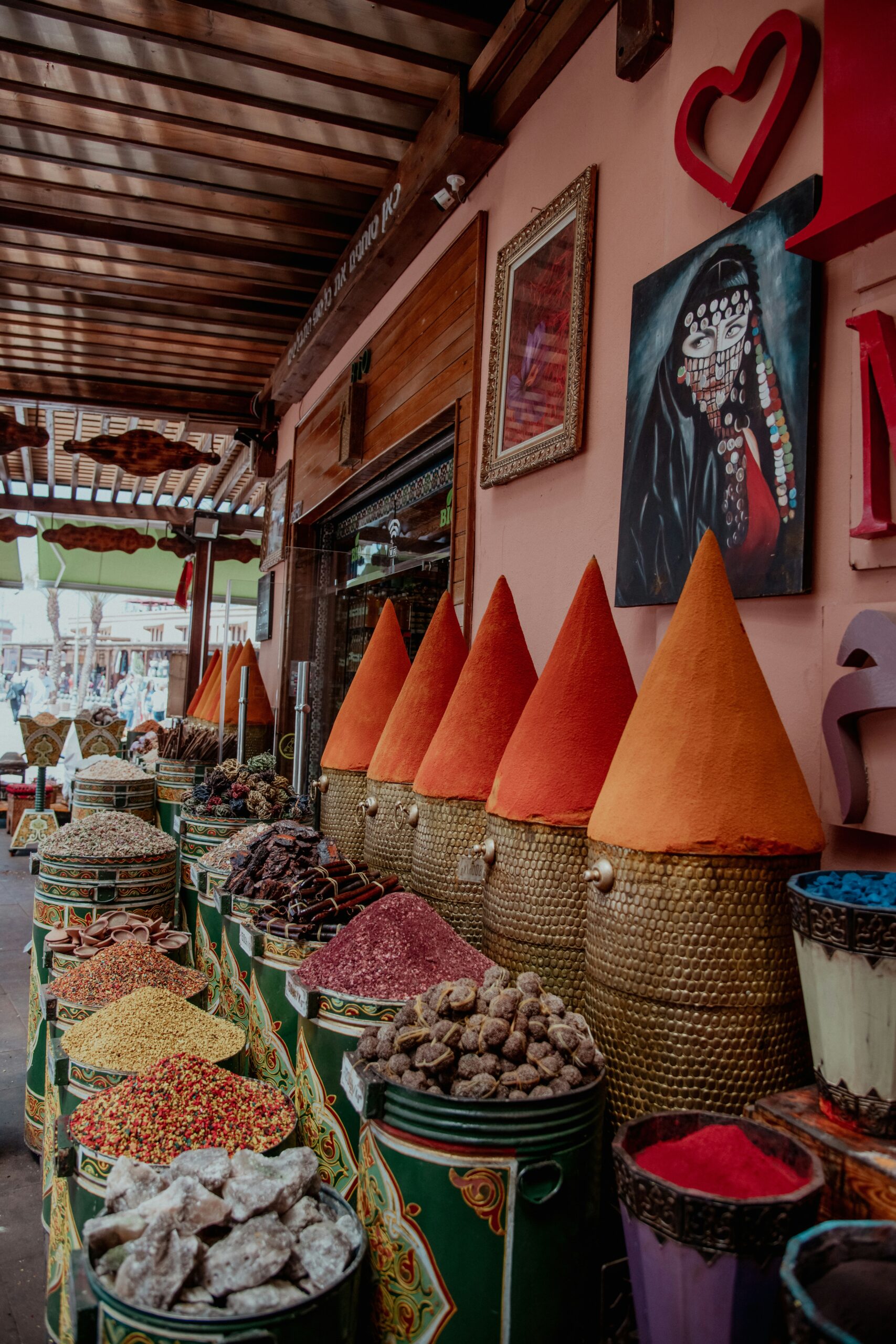
Dried pomegranate rind and red poppy petals — the two primary ingredients in Aker Fassi — at a traditional spice stall in the Fez el-Bali medina. Photo: Javier / Javier Discovers.
The traditional preparation of Aker Fassi was never written down. It passed from mother to daughter, grandmother to granddaughter, across kitchen thresholds in the médinas of Fez, Meknès, and Marrakech. What survived is a formula of elegant simplicity — two botanical ingredients, one carrier, and a stone mortar that has not changed in a thousand years.
The rind and petals are sun-dried, then ground to a fine powder using the traditional mehraz — a heavy brass mortar that has been passed through families for generations. The resulting dust is a deep brick-red. Applied to skin, it stains temporarily. The compounds it delivers, however, linger far longer than the color.
This is the quiet genius of Aker Fassi: it was never purely cosmetic. The color was the signal. The skincare was the substance. The women who developed this formula — without laboratories, without peer review — arrived at a preparation that modern biochemistry is only now fully explaining.
She had been using Aker Fassi every morning since she was seventeen. She was, she told me through her granddaughter's translation, eighty-one years old. Her skin looked like polished amber.
— Javier, Field Notes · Fez el-Bali, MoroccoMost people first encounter Aker Fassi as a cosmetic — a natural lip and cheek stain that delivers a deep berry tone. That use is real and beautiful. But it represents only half of what Aker Fassi is actually doing when applied to skin. The compounds being delivered alongside the color are precisely what modern anti-aging science most wants to put in a serum.
Aker Fassi is used for two distinct purposes simultaneously — and understanding both is the difference between using it as makeup and using it as a daily skin practice.
The deep brick-red pigment from pomegranate rind and poppy petals delivers a buildable, natural-looking stain that lasts 3–5 hours. Unlike synthetic dyes, the color fades gradually and evenly. No artificial additives, no preservatives. The result is a flush of color that reads as healthy, not applied.
The pomegranate rind delivers ellagic acid — one of the most studied topical antioxidants in dermatological research — and punicalagins, which support collagen and cellular energy production. The poppy petals deliver flavonoids that preserve both elastin and hyaluronic acid. Applied daily, these compounds deliver measurable cumulative benefit to skin structure and tone.
In the Fez medina, Aker Fassi is not a product applied on special occasions. It is a morning ritual — as unremarkable and consistent as washing your face. The cumulative skincare benefits that research now documents are a direct result of that daily consistency. The ritual is not separate from the benefit. It is the mechanism.
It would be easy to dismiss Aker Fassi as folklore. It would also be wrong. The compounds in its two primary ingredients have been studied extensively in peer-reviewed research — and the results align with what Moroccan women have practiced for a thousand years. The tradition was the clinical trial. It just ran longer than most.
You don't need a stone mortar or a souq visit to use Aker Fassi — though both are recommended for the full experience. The preparation is simple, the application takes under a minute, and the results build with daily consistency. For the full compound-by-compound breakdown of what happens to your skin when you do this daily, see the Aker Fassi skin benefits post. For how it works alongside Moroccan argan oil as a carrier, that post covers the pairing in depth.
Deep brick-red color, fine texture, no synthetic additives. Imitation Aker Fassi with synthetic dyes delivers color only — none of the compounds. See the sourcing picks below.
A pinch of powder with 2–3 drops of cold-pressed argan oil in your palm. Mix until a smooth paste forms. The oil activates the compounds and improves absorption. Dry application gives you the stain. Oil activation gives you the skincare.
Apply to lips and cheeks by pressing firmly with your fingertip, then working outward. Pressing drives the activated compounds into the skin. Dabbing leaves them on the surface.
The cosmetic effect is immediate. The skincare benefits are cumulative — measurable improvements in tone evenness and radiance typically appear after 4–6 weeks of daily morning use.
Sourcing matters more with Aker Fassi than almost any other ingredient. Imitation products with synthetic dyes deliver color and none of the compounds. The three options below are the ones I have personally evaluated for ingredient transparency, sourcing ethics, and authenticity.
Disclosure: Some links below are affiliate links. If you purchase through them, I earn a small commission at no extra cost to you. I only recommend products I have personally evaluated. Javier Discovers is reader-supported — thank you.
100% pure pomegranate rind and red poppy petal powder, ground traditionally. Deep brick-red color. No additives, no synthetic dyes. Small-batch, sourced from Moroccan women artisans.
"This is the one I keep in my kit. The color is exactly right — deep, not orange — and it absorbs differently when oil-activated than anything else I have tried."
Check Price on Amazon →Organic pomegranate rind and poppy petals pressed into a traditional clay pot — the same format used in Moroccan households for centuries.
"The clay pot is how I first saw Aker Fassi stored in the medina. There is something right about this format."
View at Inaya Morocco →Pomegranate peel and poppy petals, no synthetic additives. Best option if you need fast domestic shipping and want to start immediately.
"A solid starting point if you've never used Aker Fassi and want to try it before committing to an artisan source."
Check Price on Amazon →| Product | Pure formula | Women-led | US shipping | Price |
|---|---|---|---|---|
| Skalli Essentials | ✓ | ✓ | Standard | $$ |
| Inaya Morocco | ✓ | ✓ | International | $$$ |
| Moroccanism | ✓ | – | Prime | $ |
All three contain authentic pomegranate rind and red poppy petals. The difference is sourcing ethics, format, and delivery speed — not compound quality.
The souq smelled of cedar, cumin, and something sweet I couldn't identify. I had been walking for two hours and was genuinely lost — which, in the Fez medina, is the correct way to be.
I found the stall because of the color. A deep red powder in a brass bowl, catching the light like something molten. The vendor, a woman in her fifties, watched me stare. She held out two fingers — the price. I paid without negotiating, which I later understood was the right decision.
She showed me the application herself. Wet fingertip, small amount, pressed to the inner lip then outward. Not dabbed — pressed. The distinction, her daughter explained later, matters. Pressing drives it into the skin. Dabbing just sits on top.
I asked how long she had been selling Aker Fassi. She laughed. "I don't sell it," her daughter translated. "I share it. My grandmother made this batch."
Note to self: A product that a grandmother made and a granddaughter shares is not a product. It is something else entirely. Figure out the word for that before the next post.
Javier travels slowly — a minimum of three months per country — because the best anti-aging secrets don't reveal themselves in a weekend. The hammam attendant who shares her grandmother's black soap formula, the healer who works only by word of mouth, the market vendor who blends custom argan oil for regulars — none of them talk to tourists passing through. They talk to neighbors.
That is the Javier Discovers difference.